
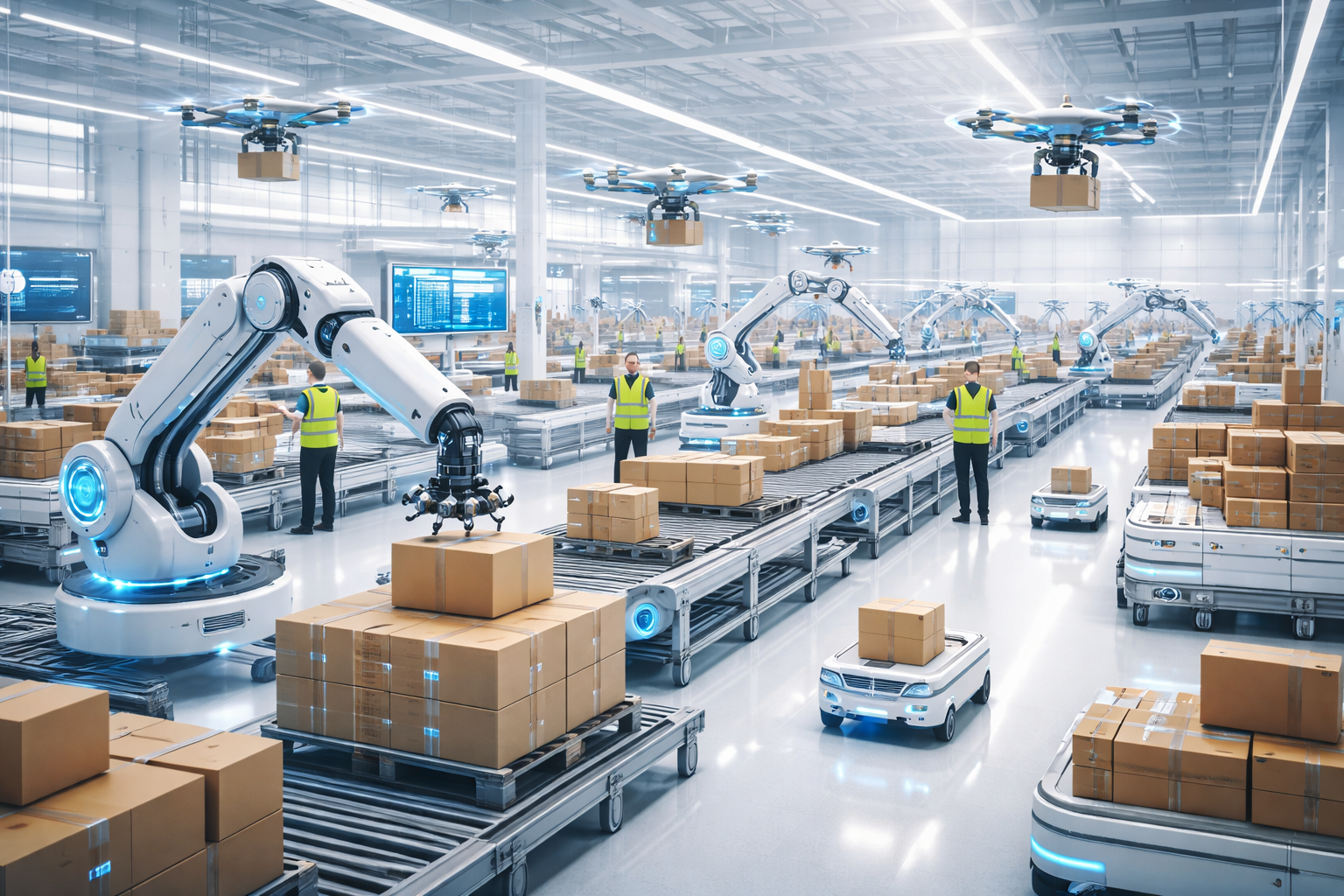
Vision-Language-Action (VLA) Embodied AI & Mobile Robotic Manipulators Solve Unstructured Inbound Bottlenecks in 3PL Cross-Docks
Contract logistics hubs and high-velocity 3PL distribution networks are breaking through the final frontier of automated warehouse execution: the handling of non-standardized, unstructured inbound freight. In late September 2026, leading warehouse robotics developers and Tier-1 3PLs announced full commercial deployments of Vision-Language-Action (VLA) foundational AI models integrated with Autonomous Mobile Manipulation Robots (AMMRs). While previous generations of automated guided vehicles and Cartesian sorters required uniform palletization, rigid dimensional criteria, and pre-programmed barcode orientations, these next-generation embodied physical AI platforms possess spatial reasoning and zero-shot grasping capabilities, allowing them to dynamically identify, lift, and singulate heterogeneous carton profiles directly from floor-loaded ocean and domestic containers.
Embodied Foundation Models & Zero-Shot Robotic Grasping
The technological breakthrough stems from unifying multimodal computer vision, deep reinforcement learning, and advanced robotic kinematics into cohesive VLA neural architectures. Operating at the edge within mobile manipulator chassis equipped with multi-axis articulated arms and hybrid pneumatic-suction effectors, the AI continuously scans unstructured freight environments. It dynamically calculates parcel center-of-gravity, analyzes surface texture, and infers carton fragility in milliseconds—even when packages are crushed, tilted, or overlapping. By eliminating the manual dependency on human lumper labor for unloading loose-loaded 40ft sea containers, 3PL facilities are reducing container destuffing cycle times from an average of 4.5 hours down to just 48 minutes per box, while virtually eliminating ergonomic strain injuries across receiving docks.
Autonomous Cross-Dock Ingestion & Real-Time WES Synchronization
Beyond physical singulation, these VLA-powered robotic manipulators interface directly with modern Warehouse Execution Systems (WES) via open RESTful APIs and real-time MQTT streaming. High-resolution optical sensors capture damaged vendor barcodes, wrinkled shipping labels, and obscure QR codes from arbitrary angles, cross-referencing electronic advance shipping notices (ASNs) on the fly to route parcels onto outbound cross-dock sorters without human intervention. In benchmark trials conducted across high-throughput Indian and Southeast Asian e-commerce fulfillment hubs, embodied robotic cross-docking achieved 99.8% sortation accuracy and boosted dock throughput by 62%. As supply chain agility demands faster dock-to-consumer turnaround, VLA robotic manipulation is rapidly establishing itself as the operational cornerstone of the autonomous 3PL cross-dock.